



Table of Contents
Why AI Transformation Is a Problem of Governance, Not Technology
AI transformation is a problem of governance because most organizations can build or buy powerful AI systems today, but very few have defined who approves them, who monitors them, and who is accountable when they go wrong. The models work. The oversight around them doesn’t. That gap, not a shortage of capable algorithms, is why so many AI initiatives stall after a promising pilot.
This isn’t a fringe opinion. According to Deloitte’s 2026 research on boardroom AI oversight, nearly three in four companies plan to deploy agentic AI within two years, yet only about one in five report having a mature governance model for autonomous agents in place. That imbalance between ambition and control is the core of the problem, and it’s getting more expensive to ignore.
What “AI Transformation Is a Problem of Governance” Actually Means
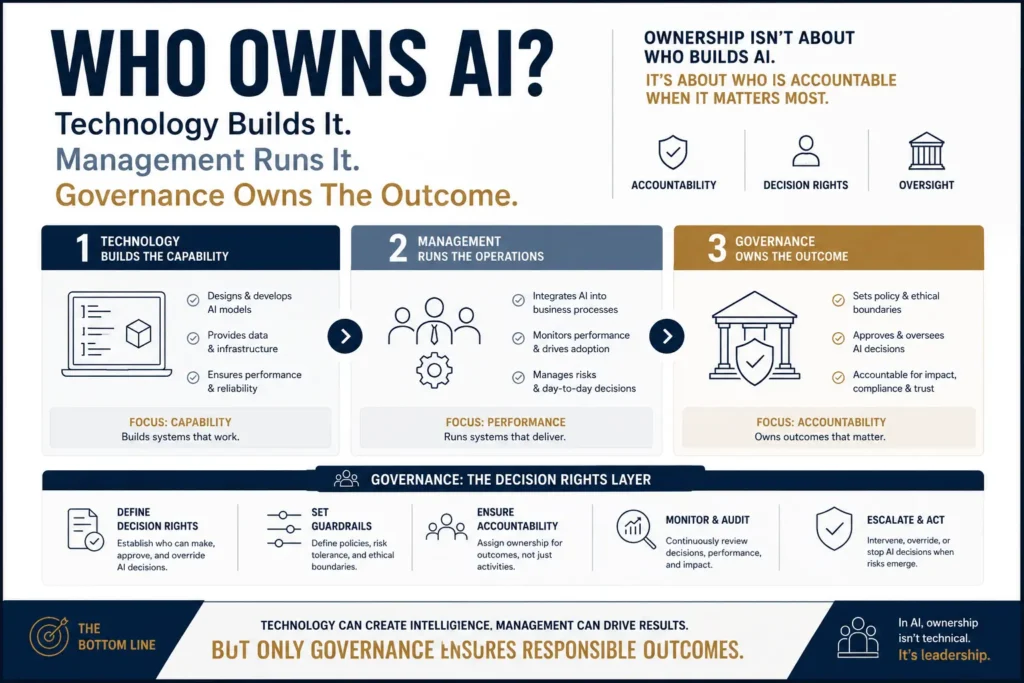
Governance, in this context, is the set of rules that determine who can approve an AI system, who owns its outcomes, and who has the authority to override or shut it down. Technology builds the system. Management runs it day to day. Governance decides who is accountable for what it does.
Most AI failures get misdiagnosed. A model that produces an unexplainable decision, a pilot that never scales past a single department, a chatbot that leaks sensitive data these get filed under “technology problem” when the actual root cause is structural. Nobody owned the decision to deploy it. Nobody defined what an acceptable error rate looked like. Nobody built an escalation path for when something went sideways.
When AI starts influencing who gets a loan, who gets interviewed, or how prices move in real time, the old question — “does the model work?” — stops being the important one. The important question becomes: who is responsible when it doesn’t?
Why AI Projects Stall: The Data Behind the Governance Gap
The gap between AI investment and AI value is well documented, and it points consistently at governance rather than engineering.

MIT research on generative AI pilots found that the large majority of enterprise pilots fail to reach production, largely because organizations never built the operational scaffolding to move a model from a demo to a dependable business process. Separately, McKinsey’s AI survey work has repeatedly found that a majority of enterprise AI deployments underdeliver against their projected ROI, and Boston Consulting Group has traced most transformation failures back to people and process issues rather than the technology itself.
None of this means the models are weak. It means the organizational muscle to deploy them responsibly hasn’t caught up with the appetite to adopt them. Spending on AI governance platforms is rising quickly as a direct response Gartner has tracked this category moving from a niche line item toward a mainstream enterprise investment, which tells you where practitioners believe the actual bottleneck sits.
Governance vs. Management vs. Technology: Where Confusion Lives
Most enterprises already understand technology and management reasonably well. Governance is the layer that gets skipped, and it’s the layer that determines whether AI creates value or liability.
| Layer | Who owns it | What breaks without it |
|---|---|---|
| Technology | Engineering, data science | The system doesn’t function as intended |
| Management | Product, operations | The system doesn’t deliver measurable business value |
| Governance | Leadership, board, risk functions | The system creates risk that nobody owns |
The third row is the expensive one. Unowned AI risk rarely stays invisible for long. It surfaces later as a regulatory fine, a headline, or a decision a regulator demands you explain and by then the cost of fixing it is far higher than the cost of governing it upfront would have been.
The Core Pillars of an Enterprise AI Governance Framework
Enterprise AI governance isn’t a single control or a one-time audit. It’s an ongoing operational capability built from several interlocking pillars.

Data governance and integrity. AI output quality is bounded by input data quality. This pillar covers data lineage, ownership, access controls, and validation — the work that prevents biased or corrupted data from becoming a biased or corrupted decision downstream.
Model lifecycle oversight. Every model needs a defined path from validation and documentation through deployment, monitoring, retraining, and eventual retirement. Without this, models drift silently and nobody notices until performance has already degraded in production.
Risk classification and compliance. Not every AI use case carries the same stakes. A framework that classifies systems by risk level — low, medium, high — lets an organization apply proportionate controls instead of either under-governing consequential systems or burying low-risk tools in unnecessary process.
Human-in-the-loop design. This defines exactly which decisions AI can make autonomously, which require human review, and which must always stay with a person. It’s not a vote of no confidence in the model. It’s a deliberate design choice for decisions where context, empathy, or legal accountability matter more than speed.
Transparency and explainability. Regulators, customers, and internal stakeholders need to understand how a system reached a given output. This has to be built into model selection and documentation from the start, not bolted on after a regulator asks.
Why AI Governance Differs From Traditional IT Governance
Applying a traditional IT governance playbook to AI is a common and costly mistake. Traditional software is deterministic: it does the same thing on Monday that it did on Friday. AI systems are probabilistic and continue to evolve as they ingest new data, which means a model’s risk profile can shift months after deployment without anyone touching a line of code.
That difference changes what oversight has to look like. An annual audit is a reasonable control for a static system. It’s nowhere near sufficient for a model making decisions in real time. Effective AI governance requires continuous monitoring, drift detection, and dashboards that flag anomalies before they compound — not periodic reviews that catch problems months after the fact.
Decision Rights: Who Actually Owns the Outcome?
Decision rights are the clearest, most practical starting point for any governance framework, because they force specificity that vague policy statements never do. Before any AI system goes live, three questions need concrete, named answers:

Who approves deployment? A specific executive or committee should sign off that this system, at this risk level, is authorized for this context — not a rotating cast of stakeholders who each assume someone else owns the decision.
Who owns the outcome when the model is wrong? There needs to be a named individual accountable, not a shared inbox that nobody checks until there’s a problem.
Who can override the system? Every automated decision that touches a person’s finances, employment, or wellbeing needs a human escalation path with clear criteria for when to use it.
Without these answers, accountability diffuses. When a lending model, a hiring tool, or a pricing engine produces a bad outcome, the question “who decided this?” bounces between data teams, product managers, compliance officers, and business unit leads — often until legal gets involved.
Shadow AI: The Governance Blind Spot Nobody Budgeted For
Shadow AI is what happens when employees adopt generative AI tools on their own, often with good intentions, to stay productive. They paste confidential notes into a public chatbot, upload internal documents for summarization, or use an unapproved tool to draft customer communications.

This is rarely malicious. It’s almost always a symptom of internal approval processes that move slower than the pace at which people actually need to work. But the governance gap it creates is real: sensitive data ends up in systems that were never reviewed, and the organization loses visibility into how its information is being used. Just like employees rushing to consume unverified gaming rumors or leaked material similar to the widespread curiosity surrounding the GTA 6 Beach Leak workplace shortcuts often bypass official security protocols before leadership even notices.
Banning tools outright tends to push usage further underground rather than eliminating it. A more durable response is to give employees sanctioned, secure alternatives under clear guidelines, paired with an honest inventory of what’s already in use, since most organizations discover their shadow AI footprint is larger than their official AI program.
The 2026 Regulatory Landscape
Regulation has moved from theoretical to operational, and the landscape is fragmented enough that multinational organizations often need several overlapping compliance strategies rather than one.
The EU AI Act imposes a risk-based framework with real penalties for high-risk systems that lack proper documentation, risk assessments, and human oversight. In the United States, the approach remains more sector-specific and voluntary at the federal level, built around frameworks like the NIST AI Risk Management Framework, though state-level activity continues to expand. ISO/IEC 42001 has emerged as a widely referenced international standard for AI management systems, built around the idea of “ethics by design” rather than compliance as an afterthought. China and the Gulf region are each developing their own distinct regulatory postures, adding further complexity for organizations operating across borders.
The practical takeaway: you cannot govern a global AI program with a single static rulebook. You need a framework flexible enough to meet multiple jurisdictions’ requirements without a rebuild every time you enter a new market.
The Board’s Role Is No Longer Optional
AI oversight has moved from an IT agenda item to a fiduciary responsibility. Deloitte’s governance research shows boards discussing AI more often and more seriously than in prior years, but it also shows that a majority of boards still describe their own AI expertise as limited. Interest is outpacing capability.
Boards that take this seriously do a few things consistently: they define the organization’s AI risk appetite explicitly, they demand real-time reporting rather than quarterly summaries, they invest in director-level AI literacy, and they treat AI performance as a standing agenda item rather than an occasional briefing. This shifts the central boardroom question from “can we deploy this?” to “should we deploy this, and under what conditions?” — a small phrasing change that reflects a much larger shift in maturity.
Building an AI Governance Framework: A Practical Roadmap
Governance is not a project with a finish line. It’s a capability you build in stages, and trying to govern everything at once is a common way to stall before you start.

Step 1: Start with one high-value use case. Pick a single process where speed, quality, or risk genuinely matter — not ten pilots running in parallel. Build your governance muscle around something real.
Step 2: Map the current workflow honestly. Identify where decisions actually happen, where work stalls, and where human judgment is essential versus habitual. Skipping this step means governing an idealized process that doesn’t match reality.
Step 3: Assign named ownership. Every AI system needs a specific accountable owner, not a committee. Shared ownership tends to function as no ownership the first time something goes wrong.
Step 4: Classify by risk and define rules. Document what data can be used, what outputs require human review, and what the escalation procedure looks like when something deviates from expected performance.
Step 5: Build monitoring before you need it. Dashboards, drift alerts, and audit trails are the difference between catching a problem in week two and discovering it during a regulatory inquiry.
Step 6: Measure business outcomes, not activity. Track error rates, compliance incidents, and time-to-value — not the number of AI tools deployed. That distinction is what separates governance theater from governance that actually informs decisions.
Common Mistakes Organizations Make
A few patterns show up repeatedly in stalled AI programs, and most are avoidable with foresight rather than more engineering effort.
Treating governance as a compliance checkbox rather than an operating capability is probably the most common. Organizations write an AI ethics policy, file it, and consider the problem solved — without ever translating principles into enforceable, measurable controls with named owners.
Retrofitting governance after deployment is another. Adding oversight to a system that’s already live costs considerably more than designing it in from the start, both in engineering effort and in the political capital needed to pause something already in production.
Underestimating shadow AI is a third. Many governance programs are scoped around the “official” AI portfolio while ignoring the much larger footprint of tools employees have already adopted independently.
Governance as a Competitive Advantage, Not a Brake
The intuitive framing of governance is that it slows things down. In practice, the opposite tends to hold. Teams operating under clear rules of engagement move with more confidence, not less, because they aren’t second-guessing whether a deployment will trigger a compliance problem three months later.
Governance also solves a coordination problem that’s easy to underestimate. Without it, marketing buys one AI tool, sales buys another, and HR buys a third none of which talk to each other, all of which create redundant data silos. A governance framework doesn’t just manage risk; it creates the shared standards that let AI investments compound instead of sitting isolated in separate departments.
The organizations most likely to lead over the next several years won’t necessarily have the most advanced models. They’ll have the organizational infrastructure to deploy AI reliably, monitor it continuously, and defend their decisions to regulators, customers, and their own boards. That infrastructure is governance, and building it now is considerably cheaper than building it under regulatory pressure later.
Frequently Asked Questions
What does it mean that AI transformation is a problem of governance?
It means AI initiatives typically fail not because the technology underperforms, but because organizations deploy it without clear ownership, accountability, or defined decision rights. The model works; the structure around it doesn’t.
Why do AI transformation projects fail even when the technology works?
Most failures trace back to unclear ownership, inconsistent data standards, and the absence of human oversight thresholds — not to weak models. Research from McKinsey and MIT both point to organizational and process gaps as the dominant failure mode, not algorithmic limitations.
What is Shadow AI, and why does it matter for governance?
Shadow AI refers to employees using AI tools that IT and compliance haven’t reviewed or approved, often to boost productivity. It creates invisible data exposure and compliance risk, and it’s almost always a sign that internal approval processes are too slow rather than a sign of bad intent.
How is AI governance different from traditional IT governance?
Traditional IT governance was built for static, predictable systems. AI systems learn and evolve continuously, so governance has to include ongoing monitoring, drift detection, and dynamic risk management rather than periodic audits.
What are the core pillars of enterprise AI governance?
Most frameworks converge on the same core elements: data governance, model lifecycle oversight, risk classification, human-in-the-loop design, and transparency or explainability. Each addresses a distinct point of failure in how AI systems get built, deployed, and monitored.
How does the EU AI Act affect AI governance requirements?
It establishes a risk-based framework requiring documentation, risk assessments, transparency, and human oversight for high-risk AI systems, with meaningful financial penalties for noncompliance. Organizations operating in or selling to the EU need to treat this as a legal requirement, not a best practice.
Can a small or mid-size company build effective AI governance without a large team?
Yes. The most effective starting point isn’t a large governance department — it’s naming a single accountable owner, inventorying existing AI use (including shadow AI), and applying full governance rigor to one high-risk system before scaling the approach elsewhere.
Does governance actually slow down AI innovation?
The evidence points the other way. Teams operating under clear rules tend to move faster because they aren’t stalling on undefined risk questions mid-project, and governance frameworks let successful pilots replicate safely across departments instead of staying trapped as one-off experiments.